

 | |
| Collectible card game | |
| Middle-earth Collectible Card Game | |
|---|---|
| Information | |
| Designer | Coleman Charlton, Mike Reynolds |
| Publisher | Iron Crown Enterprises |
| Release date | 1995 |
| Players | 1-5 |
| Abbreviation | MECCG |
Middle-earth Collectible Card Game is a collectible card game released by Iron Crown Enterprises in late 1995. It is the first CCG based on J.R.R. Tolkien's Middle-earth, with added content from ICE's Middle-earth Role Playing game.
The cards used in the game feature original artwork by a multitude of artists, many of them longtime Tolkien illustrators such as John Howe, Ted Nasmith, Angus McBride, et al.
The game's production ended in 1999, when ICE lost the license that allowed them to use the content of Tolkien's The Lord of the Rings and The Hobbit.[1] The license ended up with Decipher, who would publish their own unrelated collectible card game in 2001 to coincide with the release of the film adaptations, bringing along Middle-earth CCG's line editor Mike Reynolds.[2]
Overview
In its basic form, it is a game for one to five players, each choosing one of the five wizards to represent themselves. A turn in the game consists of one player's wandering around Middle-earth with the help of famous characters of Middle-earth, trying to gather influence and power to aid in the battle against The Dark Lord, while another player tries to harass, and ultimately kill his characters with specific hazard cards. Then, for each player's turn, the roles change clockwise around the table (the player who was moving his characters then throws hazards at the player to his or her right). Any player may also win by acquiring and destroying The One Ring after a complicated set of events.
Later expansions have added the possibility to take the role of a Ringwraith of Sauron (The Lidless Eye set), a corrupted wizard playing by his own rules (The White Hand expansion), the malevolent Balrog (The Balrog expansion), or even Sauron himself. The game is somewhat distinguished from most other CCG's with the use of two six-sided dice for a random factor and also by the actual map of Middle-earth, including regions your companies travel through, and site cards they visit.
Card lay-out
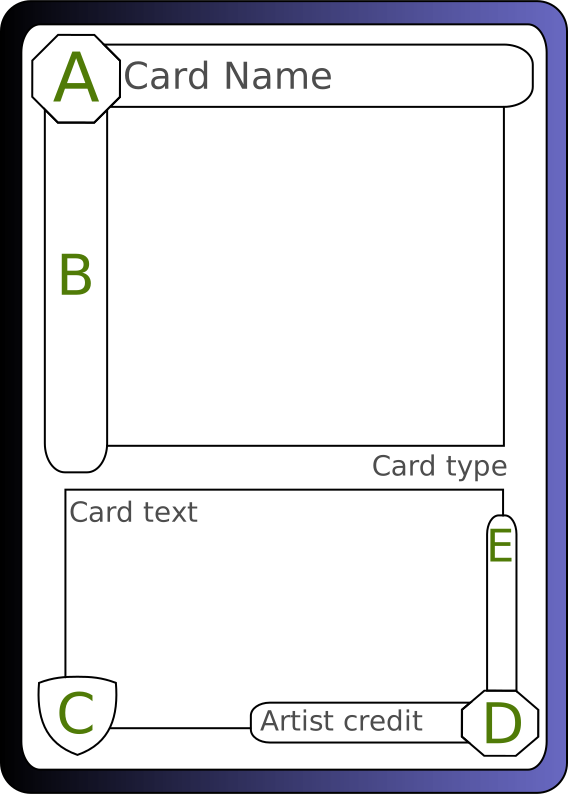
- A: Marshalling points. A rune is shown for player characters, such as Wizards.
- B: Mind & direct influence (character cards), attribute modification (resource cards), keyable regions & sites (hazard cards).
- C: Prowess / Body, or modifications thereof in case of resource cards. It is a rectangle on site cards, showing cards drawn by the player and the opponent.
- D: Corruption modifiers (character cards) or corruption points (resource cards)
- E: The number at the top of this column is used for randomness without dice. The set symbol, if one is printed, appears in the second to last space.
- On site cards, the card type shows the region instead. On character cards, they show the skills and race.
- The first limited print run of a set had black-bordered cards. A second unlimited print run incorporated errata, and had blue-bordered cards.[3]
-

A character
-

A resource
-

A hazard
-

A site


Rarity
Like the majority of collectible card games, individual cards in Middle-earth CCG occurred more or less often in a booster or starter deck (except in The Balrog expansion). To describe the rarity of a card, ICE used a code system:
- R = Rare.
- U = Uncommon.
- C = Common.
- F# or Fixed# = Part of a fixed set of cards (of a starter deck).
These abbreviations were often combined with second abbreviations (e.g., "CB2"). For more information on the second abbreviations, which varied in the different expansion and basic sets, see the Card list sections for the individual card sets below.[4]
Production

After the increasing success of Magic: The Gathering, the arrangement Iron Crown Enterprises had to jointly produce a Lord of the Rings card game with Wizards of the Coast fell through. ICE then decided to do it by itself. Looking at the existing options on the market, they quickly agreed on two core ideas: characters would be at the forefront, and the game would need a “sense of movement”. From this they settled on centring the game around the Wizards. Coleman Charlton then spent “a month or a month and a half” on designing the basic gameplay, leading towards the game's alpha phase in which test games were played with printed-out prototype decks. Felon said that of all the playtesters, the foreign groups provided more “bang for the buck”, bringing in different perspectives and being forward-thinking when it came to eventually having to translate card texts.[5]
Card design and artwork
During the playtests, Pete Fenlon went looking for artwork. According to Fenlon: “Because of the nature of the setting, word of mouth sort of spread around, and people started coming to us.” Overseas playtesting groups led to many artist suggestions. Germans led them to artist Jo Hartwig, who ended up creating a giant map of Middle-earth, as well as 52 region cards. Italians suggested Stefano Baldo and Angelo Montanini. Meanwhile, from their own United of America, artist Donato Giancola was hired based on an old portfolio. Liz Danforth had already done illustrations for Middle-earth Role Playing, and was also eager to join the project. It was up to art director Jessica M. Ney-Grimm to coordinate the massive effort. So many pieces were sent in that they had a wealth of choice. “We actually rejected pieces by a lot of good artists, having them redo them, or even shifting the pieces to another artist“, said Fenlon. Rejections were usually related to details that didn't match, which led to Ney-Grimm sending out explicit text descriptions.[5]
Artists sent their original works to Iron Crown Enterprises, and after photographing the works were returned to the artists. Because digital cameras in the 1990s lacked the necessary resolution and quality, the artwork was photographed on film. This could, for example, be 4 in × 5 in format film. To ensure colour accuracy, a control bar with known colour values was included in the photograph. [6]
The visual designs of the cards themselves was handled by graphic designers Derek Carbonneau and Nick Morawitz. They decided to give each card type a distinct border texture: resources had copper, hazards had iron, sites and regions had parchment, while characters had stone. Site cards were given a backside taken from Hartwig's map, while the regular cards had the Eye of Sauron, though both shared the same border.[5]
Its with those designs that, after colour corrections of the artwork, the final card would be composited with QuarkXPress, which was the software used for all graphic design, resulting in a high-quality digital print. This was then compared to the original artwork, a process which was repeated until the digital print was a satisfactory match to the painting.[6]
A final digital version of the card image would then be sent to Cartamundi for printing.[6]
Illustrators
Full list of every illustrator whose art appeared in the game:
Products
Card sets
- 1995: The Wizards (METW) - first basic set
- 1996: The Dragons (METD) - expansion set
- 1996: Dark Minions (MEDM) - expansion set
- 1997: The Lidless Eye (MELE) - second basic set
- 1997: Against the Shadow (MEAS) - expansion set
- 1997: The White Hand (MEWH)
- 1998: The Balrog (MEBA)
Two more expansion sets were designed, but never reached publication: The Dwarf-lords and The Elf-lords. In addition, a complete revision of the MECCG was planned to be released in 1999, which was to be named Lord of the Rings Expandable Card Game (LORE CG).[7] Before the card game's release, a set titled War Hosts was announced as the set following The Dragons.[5]
Books
- Player guides:
- Companions:
- Sites and Scenarios:
- Other books:
Mordor's Black Gate: MECCG Sites and Scenarios (ST #3345) was announced but never released.[8]
The Northern Waste, a Middle-earth Role Playing supplement, includes some sites and scenarios for the collectible card game.
Specific cards
Other products
Reception
Middle-earth CCG won two Origins Awards: Best Card Game of 1995 for The Wizards and Best Graphic Presentation of a Card Game or Expansion of 1996 for The Dragons.[9][10]
See also
External links
- Middle Earth CCG at CCGTrader
- Council of Elrond (World Coordinating Body for MECCG)
- MeCCG.com
- Software for playing online free
References
- ↑ Shannon Appelcline (2014), Designers & Dragons: The ’80s, pp. 113-118
- ↑ Shannon Appelcline (2014), Designers & Dragons: The ’80s, pp. 118-125
- ↑ "Limited vs. Unlimited Card Sets", archived from the original. Iron Crown Enterprises
- ↑ "Limited Card List", archived from the original. Iron Crown Enterprises
- ↑ 5.0 5.1 5.2 5.3 Edward Willett, "Behind the Scenes: Middle-earth: The Wizards", InQuest, #8, 1995, pp. 38-42
- ↑ 6.0 6.1 6.2 . "Photo and comments". Facebook
- ↑ James Knight, "Focus On: Coleman Charlton of ICE", CarolinaCon Regional MECCG Newsletter, 4, January 1999
- ↑ "Coming Soon! Mordor's Black Gate". Iron Crown Enterprises
- ↑ "1995 list of winners", archived from the original. Academy of Adventure Gaming Arts and Design
- ↑ "1996 list of winners", archived from the original. Academy of Adventure Gaming Arts and Design
| Licensed Card Games set in Middle-earth | |
| Collectible Card Games | |
| Middle Earth CCG (1995-1998) • Lord of the Rings TCG (2001-2007) | |
| Magic: The Gathering Expansions | |
| Tales of Middle Earth (2023) • The Hobbit (2026) | |
| Living Card Games | |
| The Card Game (2011-2024) • Adventure Card Game (2022 digital) | |
| Trick-Taking Game Series | |
| Fellowship of the Ring (2024) • Two Towers (2026) | |
| Other Card Games | |
| Tarot (1997) • The Hobbit (2012) • War of the Ring (2022) • Duel for Middle-earth (2024) | |